Revelations
Emiliano Cáceres Manzano
“Fuck you. I’m a prophet.”
Angels in America: Perestroika, Act IV, Scene 1
Brother James sent Hannah to San Francisco to show the people God. As she descended upon SFO, the fog rose up to meet her and she thought maybe this was heaven. Later, she walked out of the terminal directly into a mango-scented cloud of vape smoke. She coughed and rolled her suitcase off the curb.
Hannah Ubered from SFO directly to the Oakland temple of the Church of Latter-Day Saints. She tried to make conversation with the driver, but he was wearing his headphones and talking on the phone. Meanwhile, the radio played an ad for a prayer app. This Sunday, join stars like Chris Pratt and Mark Wahlberg for guided meditation on the Hallow app! The car rose up and down on enormous hills and Hannah felt small, like a pea on a breathing dragon’s belly. She thought of home—of San Antonio—of Elder James, of his 72-hour brisket, of the impeccable leather smell of her mother’s car. Before she left, Elder James gifted her a Book of Mormon bedazzled by the sisters of the San Antonio temple. “This is the beginning of your life’s work,” he said and patted her wrist with clammy hands.
She had been somehow comforted by the sweat.
My life’s work. Hannah rose and fell on the dragon’s belly, dipping in and out of the fog. The fog washed her of the memories, the movement of the car scrambled her stomach, and she felt both adrift and insistently embodied. She arrived at the temple carsick and eager.
—
John hitchhiked to San Francisco, and hadn’t been expecting to stay. It was March of his junior spring at Rutgers. Laundry mounded on his bed and, day by day, he found it harder to burrow out from underneath it in the mornings. Everyone else’s future coalesced around them, like a shell hardening, while he sat in his apartment and read and smoked and listened to Sufjan Stevens, the days passing undistinguished, perpetual today.
John was the kind of person who was full of references. He was reading Patti Smith’s Just Kids at the time. “Where does it all lead? What will become of us? Those were our young questions, and young answers were revealed. It leads to each other. We become ourselves.” He kept waiting for the young answers. He kept waiting to become himself. But all he became was unshaven.
John tried to build himself out of fragments of other people. He felt like an unclaimed Greek pot in a ditch somewhere, dusty and awaiting reconstitution. As winter thawed and spring break approached, he took it upon himself to do something that made him feel alive. His questions, if anything, seemed old rather than young, so he decided to write himself into one of the oldest stories of all: he would embark on an odyssey. Which is how he ended up hitchhiking. His project? To encounter as many new people as possible. To catalog them so that he could put them all in one place and skim a finger down the page and maybe find his answer there among them.
He packed one bright green duffel bag with clothes for two weeks. He shaved and rubbed his newly smooth chin and tried to feel like a baby—fresh and prone to delight.
As he hitchhiked, the people that picked him up were mostly old truck drivers, because they, too, were looking to be kept company. Most of the time, they did not talk. Just radio and silent companionship. He heard an ad for a prayer app that involved Mark Wahlberg. In between rides, on the side of the road, he read Middlemarch because he wanted to be consumed by something big. “If we had a keen vision and feeling of all ordinary human life,” George Eliot said to him, “it would be like hearing the grass grow and the squirrel’s heart beat, and we should die of that roar which lies on the other side of silence.” Occasionally, a truck blared past and left John receding into silence.
Over the course of his journey, he had compiled these images: cornfields whispering in the Arkansas night, a teenage girl rowing her way down the Mississippi, a mountain lion eating a deer on the side of the road, a startlingly handsome Mexican fruit salesman who sold bright orange mangoes, St. Louis empty at night except for a jazz trumpeter. He filed them away and when he was feeling aimless, he ran his hand along the grooves of their specificity.
At last, there was San Francisco. It rose out of the mist like a ruined city from a lost civilization. He arrived on a soggy Sunday morning. For the last leg of the trip, he had hitched a ride with a milkman who dealt in non-dairy milks. The milkman dropped John off in Golden Gate park, where he saw a flock of ravens eating a sandwich. John imagined they were speaking to him. Or maybe he was just sleep deprived, but he—newly a nomad—was not exactly in a position to overlook what could potentially be a welcome, so he listened to them anyway. He decided to stay. He challenged himself to learn the city. To meet all of the people in it. The only person he knew from San Francisco was his cousin’s long-distance girlfriend of six years, Rhayna. She had been over to Thanksgiving a few times and they had bonded over a love of Final Destination. He called her and asked if he could crash on her couch for a week. She said yes. The crows cawed. John smiled and cawed back.
—
The Oakland temple of the Church of Latter-Day Saints was big, white, and pointy. It had seven perfect gardens lined with palm trees. On her first day, Hannah met the director of the Temple, President Hodgman. He was tall and gaunt, with red hair greying on the sides. He smelled like Abercrombie and Fitch cologne. Like most Mormons, he was incredibly good at conversation.
President Hodgman gave Hannah a tour of the facilities, which included a playroom for young children, four classrooms for Institute classes, and not one but two kitchens. Hannah asked if anyone else was coming to join her on the mission; President Hodgman said the other girl’s mother had recently passed. “Earthquake in Mexico City,” he said. “These things happen.” It occurred to Hannah that San Francisco had earthquakes too.
President Hodgman dropped her off in a room off of the Visitor’s Center. The room was entirely white except for a painting of Joseph Smith digging up the Golden Plates on a hill by his house. The angel Moroni directed him toward his destiny. Hannah liked the way Smith was painted gouging into the Earth with his raw hands, his face hungry for the angel’s revelations. She thanked President Hodgman and set about putting her stuff in the closet.
Hannah waited all day for the sun to set, for her favorite part of every day had always been the meditative final minutes before sleep. That first night, she put on her favorite pajamas and spritzed the room with lavender room spray. She turned off all the lights, then laid and looked up at the darkness, which was as thick and tactile as the ceiling. She talked to God. She did this every night, at first because she had been taught to do it and then because it had become her own, a kind of privacy that was not lonesome. He would answer her in her own voice. The dark was her friend, an extension of her. Sometimes she thought she could even taste it. This is when her belief felt the purest, when she was alone and the room breathed along with her. She fell asleep to the monsterly moaning of cars and the roar of waves in the bay.
—
Rhayna knew a guy who imported shrooms from Canada. John started selling them to pay Rhayna back somehow and extend his stay. During the day, he mostly hung out in Golden Gate Park and read Joan Didion like a travel guide. “It’s a social movement, quintessentially romantic, the kind that recurs in times of real social crisis,” she said to him. “The themes are always the same. A return to innocence. The invocation of an earlier authority and control. An itch for the transcendental, for purification.” Reading this, John felt both less lonely and less unique. He did a lot of looking out into the bay and thinking. He wasn’t exactly sure what he was waiting for, but he was reading so much he kept seeing signs. Hippies who looked like they had teleported from 1976. A woman churning butter in the middle of the park, selling a pound for $7.77. Cars with no one in them. The past had piled up and now smelled like weed, and the future was already here. The city sagged with accumulation. In the park, there was nothing ahead or behind — somehow all of history had converged here and now and it was just going to keep on going. And he was outside of it, doomed to keep on growing from nothing on the periphery, like a mushroom.
When he sold the shrooms, John wished his customers engaged more, but he realized when they came to him, they were only looking for business, not connection. They did, at least, remark on John’s friendliness and also told him he smelled good. John decided this would be his favorite compliment because he got it so often. The first thing he bought when he made more money than the rent he had negotiated with Rhayna was a fifty milliliter bottle of Le Labo cologne.
As a side effect of the job, he partook in a lot of his own product. In the afternoons, John would order a chamomile tea from Starbucks, toss some shrooms in it, spritz himself with incense-scented Le Labo, and lay back on the grass. A crow liked to perch on the lowest branch of the tree closest to him. He asked how it was and the crow said it was scared. John assured it that he was too.
—
On Fridays and Saturdays, President Hodgman would drive Hannah across the Bay to SF to convince people to come to church on Sunday. He would give her twenty dollars in cash for lunch and drive off to the rest of his presidential duties, which involved a lot of Zoom calls taken while driving.
Hannah had most of these Fridays and Saturdays to herself. She usually ended up in Golden Gate Park because it was full of people looking for something to do, the perfect kind of people to evangelize. The blue plastic rhinestones on her Book of Mormon winked at the passerby. Nobody winked in return. One time she went up to a woman who seemed friendly; she lounged on a bench and wore big sunglasses. Her face was creased with smiling.
“Excuse me, ma’am,” Hannah said. “Would you like to come to church with me tomorrow?”
The woman pushed her hair back to reveal earbuds. She removed them. “Sorry, I don’t have any change,” she said and put her earbuds right back in.
The days were misty and long. She found herself watching all the people who didn’t watch her: the tech bros, so serious in their wrinkled Uniqlo; the homeless people writhing on the grass; the runners speeding past, eyes ahead and unseeing. A life’s work. How lucky she was to have been born into something to live for. She felt ashamed for all those aimless people, those who had to wonder what to do with this gift they had been given, this gift of living. To be called was to have a light shined onto your face and for your pores to open up to receive it. It was noble. If she was honest, though, while she did feel noble on those long Friday and Saturday afternoons, she also felt lonely. She had so much she wanted to share and she was unsure of who to share it with.
One Saturday, she spotted John sitting on a bench, listening to music with his eyes closed. She liked his face. His ears were a little big for it and his stubble made him look somehow younger rather than older. His face reminded her of the kinds of faces you make from arrangements of inanimate objects. She decided to approach him.
“Hey, there! My name is Hannah. I’m with the Church of Latter-Day Saints, right over across the bay in Oakland,” she said. She pitched her voice up a little like she always did talking to strangers to make them feel more comfortable.
He opened his eyes and they were wet and squinting. “Ummmmm...”
“Would you like to come to church with me tomorrow morning?” Hannah made sure to smile here.
John didn’t think before replying. “Are you hitting on me?”
Hannah laughed. Then John laughed at the fact that she had laughed. “Do you believe in God?” she asked.
John took a moment to look at Hannah and process what she was doing. He liked the rhinestones on her book. A part of him did think she was hitting on him. He wasn’t sure if he believed in God but he did believe in interesting experiences, so he went with what he thought would be the more provocative response: “Not really, no.”
“Why don’t you come to church tomorrow?” she insisted. “No need to convert or anything. Just come be with other people—we don’t bite.” Hannah watched John think through what she had said. She liked how much he was thinking. She liked being taken seriously.
On one hand, John had a general distrust of organized religion because he thought cynicism suited his brand. On the other, he was intrigued by Mormons in a sort of ironic, anthropological way. And he liked this girl with a sad face and limp, bedazzled book. He told her he would come to church.
—
That Sunday was John’s first time at a service of any kind in a decade. He was surprised by the testimonial structure. The congregation spent the last half hour listening to people talk about how much they loved Jesus and how eagerly they awaited his arrival. A short Hispanic man took up the bulk of the service. He spoke about Him casually yet animatedly, like Jesus was a guy he saw at the bus stop regularly and who had stopped showing up but would be back any day now. John admired the man’s certainty about the future. His English even seemed to get less accented as he testified. A girl in the back of the mass played Candy Crush the whole service and only looked up to take communion. In the long silences, John listened to the water burble in the fountains outside. He breathed in and tried to welcome Jesus into his soul. Or whatever else the crowd was doing.
Meanwhile, Hannah watched John’s attentiveness. She watched him squirm in his chair and she watched him nod along to the testimonies without even thinking about it. Hannah had been nervous; she wanted to make sure John enjoyed himself. She did not necessarily want to convert him. Rather, seeing the service reflected in the shine of his eyes, she considered that he could be someone to share the bigness of the world with.
After the service, everyone came up to shake John’s hand. John found himself wanting to, if not convert, at least come back; Mormons had very firm handshakes.
Somewhere beyond the crowd, Hannah chatted with the congregants. John overheard them laughing and talking about a recent Mormon horror movie starring Hugh Grant. He had watched it the previous week. John was startled by this continuum of reference between them; suddenly, he felt closer to Hannah: this stranger who had asked him to come to church and had given him the potential for something new.
Hannah asked John if he wanted to have lunch together. She felt like keeping the momentum of their mutual excitement going. He said yes, so they went to the pub right outside the temple, Monaghan’s. The green walls were plastered with ads for Irish beer from the 70s and it was full of men who were big, smelly, and friendly. Somewhat anachronistically, the main source of music was a rusted radio in the corner. They each ordered a burger and they split an order of onion rings.
“So, did you like the service?” Hannah asked John after a brief eating-induced silence.
“I did,” John replied. He nodded to make sure Hannah understood how honest he was being.
“I’m glad.”
“So,” John said, taking a bite of his burger. Juice dribbled down his chin and Hannah wasn’t sure whether to tell him. “Is this what you do all week? Try and get people to come to church with you?”
“Pretty much. That’s what we do on missions. And go to Institute. Be a part of the temples we go to.”
“Institute?”
“Like Bible study.”
“Every night?”
“Once a week. They have food.” John smiled. “You could come if you wanted!”
“Come back to me in a week,” he responded, nodding all along to convey that he would.
Hannah delighted in how easy John was to convince. All she had to do was bribe him with food and certainty. Even if he wasn’t going to convert, Hannah did feel like she was showing him something. She felt like she was showing him the part of herself that she found in the dark, laying in bed, the part that extended beyond the confines of her physical body. They finished their burgers while John explained college football, which was playing on the TV above the bar.
“Can I play a song for you?” John asked after the game was over.
“Sure,” Hannah replied.
John spent a full minute trying to untangle his headphones. “Do you know Sufjan Stevens?”
“I don’t.”
“Well, this is him.”
He offered her his headphones and she held one back out to him. He declined it and insisted she wear both, then hit play on “The Hidden River of My Life.”
The sad surprise, the day it feeds, the flooding falls, the cliff or chime. John could tell where Hannah was in the song by the rhythm of her nodding. He imagined himself into her head to keep pace with the song. Awake my soul, awake my heart, and you will find. He liked the song because of its omnivorous collection of images and words, its curation of instruments and human sounds. I’m a lover, yeah, I’m a weeper, Subaru driver, satellite receiver. In its attention and precision, it reminded him of his hitchhike across America and he felt in this way, he was sharing it with Hannah.
The song ended. Hannah savored the last dregs of it, then reached out across the table and held his hand. She squeezed it. Dust motes floated in a beam of sunlight between them. “Thank you,” she said. And with her breath, the little motes parted and vanished.
—
John started coming around a lot after that. Hannah brought him to breakfast-for-dinner night at Institute. John grew endeared by how much Mormons loved to eat.
Every Sunday for the next seven Sundays, Hannah would pick John up in Golden Gate park. He began to prepare little gifts for her to thank her for making the drive: a branch twined up in ribbon, a snippet of a poem he had copied down, dried flowers, a 99-cent vintage store polaroid of a pioneer couple. She felt like his nest. She liked the part of the poem that read “But all the clocks in the city / Began to whirr and chime: / ‘O let not Time deceive you, / You cannot conquer Time.” She was beginning to understand John’s conception of the world beyond himself: his insistence on the present, his curiosity, his uncertainty.
She liked the gifts, too, because she liked having a friend. He was so specific. He liked the Astros and old sneakers and incense scents. He was someone she could attempt to reach for and understand. Someone whose expanse of details she could traverse. Someone unexplored who was slowly revealing himself to her, though there would be no final answer.
John liked talking to Hannah because she was so different. Unlike anyone he had known before, Hannah talked about God unapologetically and with utter certainty, like the man at service. The world through her eyes was dusted with proof of holiness. A whole new world of references opened up for him unexplored, the limits of what seemed possible in the world suddenly malleable. He grew more open and more perceptive, like a tree unfurling its leaves to soak up the sun.
—
“Have you ever had a vision?” John asked Hannah one day at Monaghan’s. The Astros were playing and he needed some of her certainty in his life.
“Like, of what?” Hannah asked.
“I dunno. God? The future?” John took a large bite of his burger.
“Not really.”
“But aren’t Mormons supposed to have those? Isn’t that the whole thing? Didn’t that guy have a vision of the tablets or whatever they talked about at Institute the other day?”
Hannah thought about it. He did have a point, Joseph Smith and all. “I mean,” she tried to find words for it. “One time, I dreamt my dog died. I was coming down the stairs and I found him in his little doggy bed next to the fridge. And then, three days later, I came down the stairs and he was dead.”
John put down the fry he had picked up. “Whoa.”
“It was probably a coincidence.”
“No, no, that was totally a vision.”
“I guess. It was more of an omen, really.” Hannah didn’t necessarily want that to have been her only vision. She was worried she had come off morbid. But the more she thought about it, the more she realized that all the visions she could think of in the scripture were of either something beginning or something ending—the tablets for founding the Church, the Apocalypse of John. Or really just things ending, what with all endings being beginnings in their own way too. Visions brought certainty. She wondered if her talking to the darkness counted as a vision if the darkness talked back.
“Either way, you saw something.” John popped the fry into his mouth. “And isn’t it better to know what’s coming?”
—
John offered Hannah shrooms after service on the seventh of their Sundays.
“I’m not going to do that,” she replied to him. She was dropping him off in the park. She could drive him now—President Hodgman had finally let her borrow his car.
“Why not? I know a Catholic priest who buys them from me because he thinks they let him speak more clearly to God.”
“Do they?”
“Only one way to find out.” John raised his hands in mock defeat. “You can’t know ’til you’ve tried them.” Hannah had shown him so much of her life, he told her, and now John wanted to show her some of his. He wanted to see if he could muster up a little bit of the sacredness that Hannah seemed to be so in touch with: transcendence by osmosis. “Besides. They’re a natural plant.”
“Fungus.”
“Fungus. Right.”
Hannah could not believe she was considering it, but all of John’s points made sense. She wondered what she would encounter if she tried to induce a vision with John beside her. She wondered if it would help her understand him better. Until coming to San Francisco, her faith had been so private, but since meeting John she had begun to consider the potential of God experienced in conjunction with somebody else. If she took them to get closer to God, then God couldn’t possibly be mad. And John was right: they were naturally occurring. “Why does he buy them from you anyway?” she asked.
“He likes to support small businesses.” John smiled and laughed to himself. He liked to make himself laugh.
“Alright.”
“Seriously?”
“Let’s go, before I change my mind.”
John went to Starbucks and bought two chamomile teas. The barista was named Ted. He had a thick mustache. He nodded at John, smiled in recognition, and gave him two cups. He drew a smiley face into the O of “John.” Outside, John brought out a small, unlabeled plastic bag with a bunch of dried mushrooms. He sprinkled some into each cup and let them brew as he walked her to his favorite clearing in the park. It had a big rock in the middle on which they laid and sipped their tea and talked about Joan Baez’s “House of the Rising Sun.” Hannah sipped carefully, but as they talked, her insides got all warm and it didn’t seem to matter what she was drinking. A few feet away, by a tree, an old woman in the sun did tai chi.
John had never taken anyone to his perch in Golden Gate park. He called it the Podium. Called it, that is, to himself—he never even referred to it out loud. But it felt right that if she had taken him to church, he would take her here. They finished their tea and laid on their backs on the stone. John’s sweater rode up and the cold grey stone pressed against the small of his back. He looked over at Hannah and she turned over to look at him.
—
She is lying on the stone and watching the sunlight filter through the leaves. She turns her head to the side and sees the grass, stretching like taffy. It is green, then greener. And then she turns her head back skyward to see the trees weave into each other, branches knitting into seven thick braids that reach up to the sky. Her body feels unfinished, like she has limbs where she didn’t even have limbs to begin with. And she feels light. Her heart pumps helium instead of blood. She notices now how she can see the sunlight through her eyelids every time she closes them. She has the urge to laugh.
Just beyond the clearing, the trees uproot themselves. They tear from the soil and begin to levitate until the ground is rippled over with mounds of dirt. Each of the holes bubble with something thick, black, and sticky — oil. It smells like money and rotting. She is still holding her Starbucks cup. She clenches it and the pressure of her grip converts the tea water inside it into diamonds. In the distance, a siren sings. Then, standing behind her on the rock, a figure, just a foot away from her. She feels them before she sees them, and when she does, their back is turned to her. It’s Ted, the barista. Makes sense. His mustache did seem to be full of secrets.
He turns around to look at her. All of Ted looks, that is to say, because he is covered in eyes—multicolored eyes, pupils dilating, eyes all over his face, under his mustache, looking from his elbows, and one piercing blue one at his Adam’s apple. She calls his name. Or she tries to. All that comes out of her mouth is the sound of radio static with the occasional commercial. But somehow Ted understands her. His eyes close all at once, then open. He parts his lips and, without moving them, he says: “Do not be afraid. I am the First and the Last. I am the Living One; I was dead, and now look, I am alive for ever and ever! And I hold the keys of death and Hades. Go forth and announce me.” And then his mouth pours out yellow smoke that smells like mangoes.
She coughs. She hacks and biles and phlegms. She doubles over, drops her cup. Diamonds impale the grass. She wonders if she is going to die.
Ted is gone. She looks up. The sun clouds over with bugs. Little bugs, metal, with eyes made out of cameras. Their wings sound like record players when a disk is finished. Finished finished finished, they scratch. On the streets, which she can see now through the dangling roots of the floating trees, a herd of horses gallops through the intersection, seven in all, white, black, made of fire, made of metal. Tremors of an earthquake shake down the clouds until they fall on the ground and shatter into a fine mist with the enormously flatulent sound of a giant stomping bubble wrap. The clock on the ferry building chimes and the sound reverberates through her stomach.
She watches time whirr by. She watches the tall buildings freeze over, turn opaque, the people inside suspended like flies in amber. She watches the Painted Ladies, those old Victorian houses, heave sewage out their front door then hack themselves dry after five minutes. And she watches the cars, all empty, turn to each other and begin laughing.
She begins to worry. She worries about what is beginning here, when all this is coming, and why. She worries that God has judged the world and found it wanting, that He has somehow turned His back on His beloved creation, that they have failed Him, that they are now past the point of no return, advanced into oblivion. Why is He showing this to her? Why does she keep having visions of things she does not want to know? She wonders if the world is worth saving, then wonders if that is even something worth wondering now that she knows it is going to end. It begins to rain: water, then hail, then gravel, then fire. She raises her hands up to cover her head, but each of the elements travels right through her hands as though she herself is made of smoke.
She kneels down and repents.
She repents for the drugs, but also for her soul, for John’s soul, for all those aimless, wandering souls—which is to say everyone. She can see the souls now, rising up, thick clouds in heavenly shades of teal and turquoise and purple, spooling onto the branches of the trees like cotton candy and whispering their sins like doves toward the sky. She tries to talk to God and this time there is no answer. Maybe this is His answer, the End.
The End is a promise. It means receiving the answer to millenia of questions. She does not know whether it is scarier knowing that the world will end or thinking that it will go on forever. Because, regardless, here she is. She has arrived at the place past hope. She knows that she is supposed to feel blessed with sight—that’s what prophets are meant to feel. She knows we need endings, too. They give life meaning. But what about what happens before them? What about the middle? There must be meaning there too.
The rock scrapes into her knees. She knows she is bleeding. And still she keeps praying.
There is still so much we could do better. There is still so much hurt. There is still so much uncertainty. Uncertainty may be its own kind of damnation but she is certain it is also no apocalypse. It is a kind of blessing, its own kind of meaning. The kind of meaning that comes from articulating a question before you even know if there is an answer.
Everything stills. Hannah takes it in: the frozen skyscrapers, the laughing cars, the levitating trees, the fiery horses, the bugs darting through the sky. She listens to the souls. Hannah knows this is the end and also, equally, she knows that it is not now. She turns to John, whose eyes are open, and in their reflection she sees a blue, ordinary sky and an old woman doing tai chi. For now, there is still living to do.
—
The next Sunday, at Monaghan’s, Hannah told John about her vision. It scared him. It scared her. He said he had not seen Ted since that last Sunday. It seemed like a sign, and John wished he had not seen it as such. Hannah wondered where Ted had gone.
Then, from somewhere beneath their feet, they felt a rumbling. The glasses of water on their table shivered, their chairs pressed up against them, as though rebelling against their use. The baseball game on the TV bounced up and down slightly, the radio crackled, and there was a groaning from the bowels of the Earth, primal and bone-deep. The bartender ducked behind the bar. Hannah thought for sure this was it.
But just as soon as it started, it was over. The water, the chairs, the game, the Earth and the bartender all settled back to normal. Outside, the cars kept whirring, the people kept walking without looking, the ocean kept churning, and the clocks kept ticking inexorably ahead ahead ahead. Inside, Hannah and John looked at each other in terrible amazement, perched on the edge of precarity, sharing a secret of what was to come.
Emiliano Cáceres Manzano is a senior English major in Benjamin Franklin College.
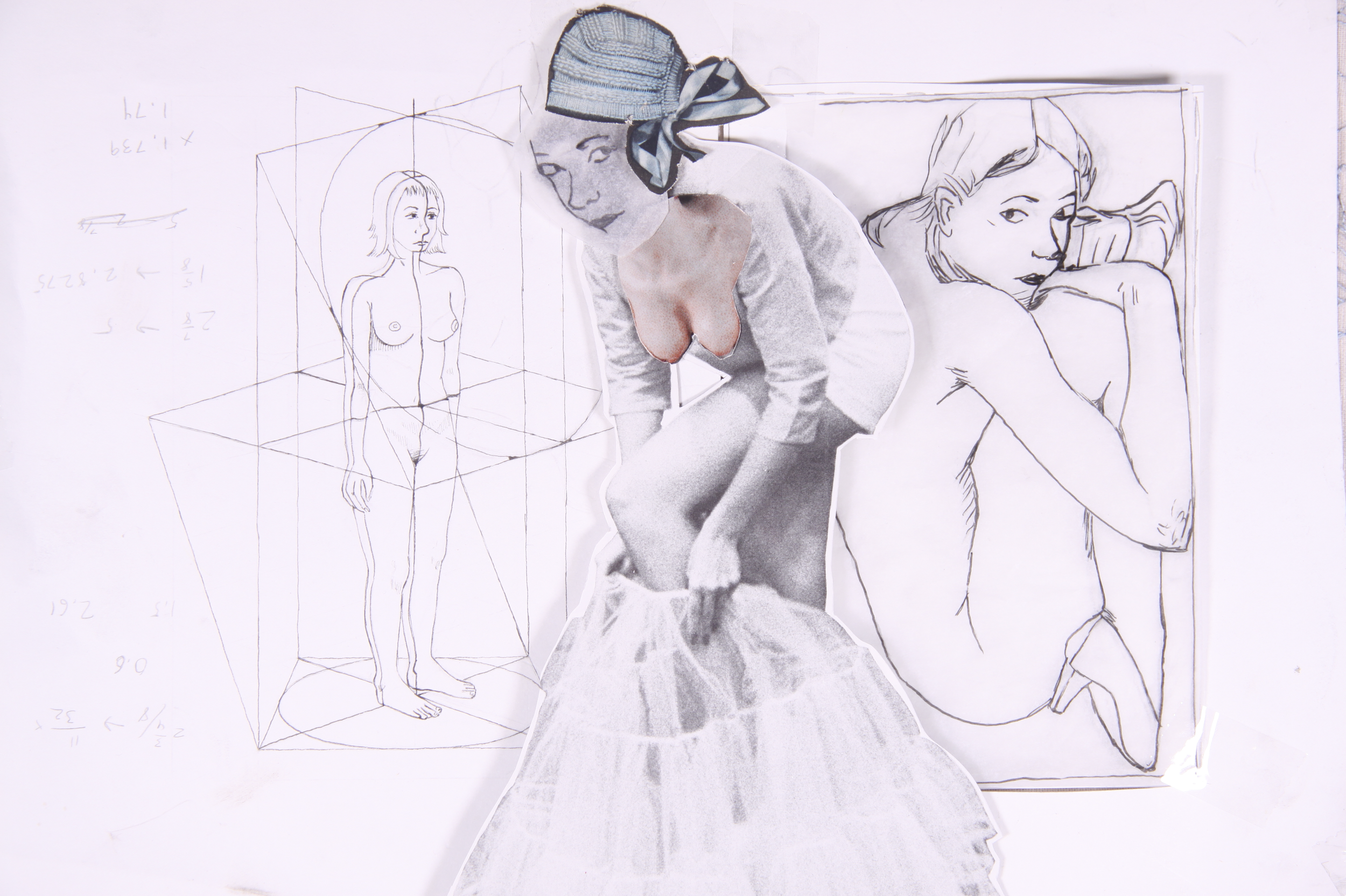
ABOUT THE ART | Collage by Malina Reber, 2026. Malina Reber is a student at Yale University.